New direction control for skis
has been developed in Austria in the years 2006 and 2007.
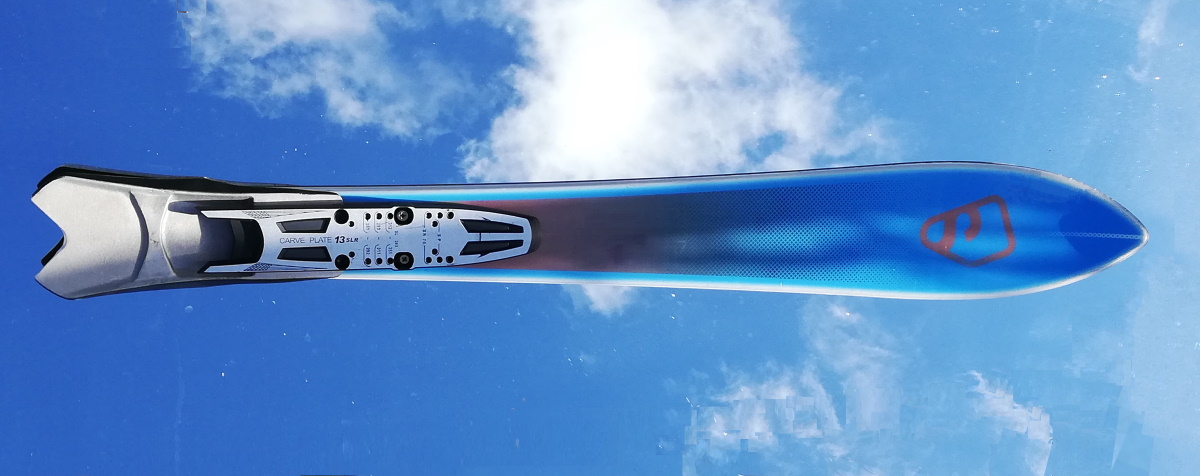
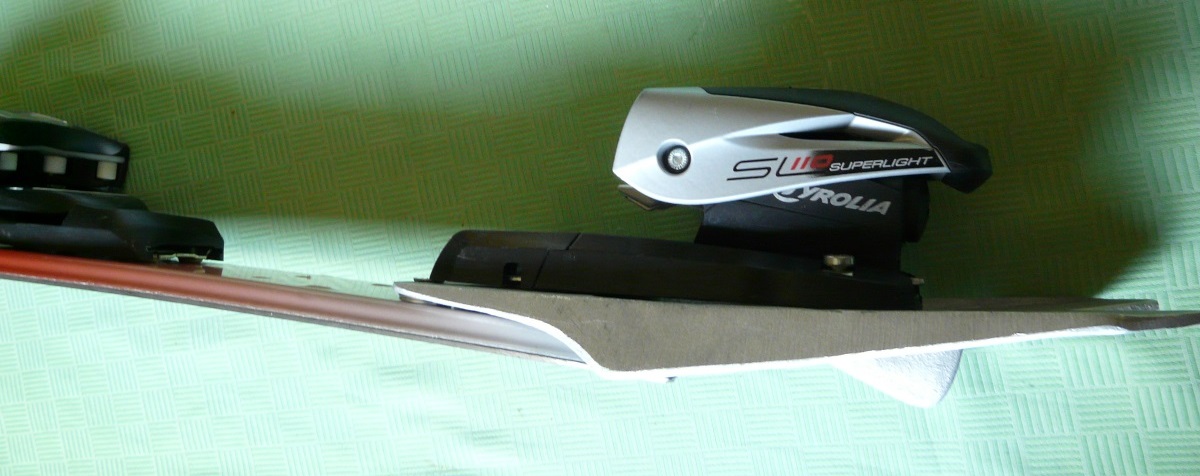
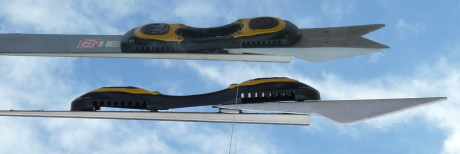
A diagonal carrier holding vertical metal fins was erected on the ski, just behind the binding.
The fins carving in the snow operate like skate skids when the ski is running on hard pack and ice
or like surfboard fins when skiing powder and other soft snow arts.
The fins should be located above the ski's gliding surface, behind the ski boots and as close to them as possible
in order to bear the skier's weight directly. These 3 requirements are discussed further on this site.
Until Autumn 2007, we did not succeed to place the fins closer than 20 cm to the heels.
This deficit limited the implementation of fins to very short skis and soft snow.
Beyond this range, only well-trained skiers were able to transmit the body weight to distant fins.
The Rax Generation 2008

solves this problem by shifting the diagonal carrier forward on ski (ski binding is mounted on the carrier itself)
and extends the application range to hard pistes and icy couloirs.
All modern skis such as All Mountain, shaped carver, downhill competition, monoski, etc
can be equipped with fins control, losing 20 cm of their original length on overlapping part under the boot.
Here is the promised marriage between the "carver technology" and the "rax technology":

Regardless of these new possibilities we still recommend short or even very short skis of Rax Generation 2008
for freeride and piste. They let you enjoy easy skiing, minimize accidents and avoid shin bang
(injury of foot or shin caused by the leverage effect of long ski on them).
Ski technique
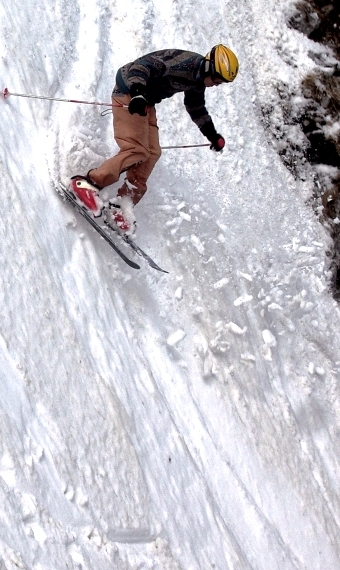
The new ski supports parallel and carve turns as well as a new turn "on the fins".
Keeping the skier's weight forwards promotes the gliding and disables the new turn on a hard surface
as this position disengages the fins from the snow.
The "normal" position of skier (straight line connecting heel with weight center is perpendicular to slope)
activates the fins. From now on the skier controls the direction with his feet: turning them right lets skis turn right, etc,
Older Rax models required backward position to produce enough pressure on their distant fins.
That is why we are not recommending them for hard piste and ice.
Parallel and carve turns can alternate with turns "on the fins" as the skier can transfer his weight between turns.
Some elements of them can be combined even during one turn. A slalom turn can be initiated with sharp angulation
while the weight ist extremely forward and then executed "on the fins" as fins carve deeper and never skid away.
(The carve technique rotates both skis and the fin technique executes the curve).
Click here to get pictures and text as pdf
Die ganze Geschichte mit Fotos als pdf (german version)
Riding down the Rax, Dec 1st, soft, heavy snow (short video)
Skiing piste
No other ski supports so fast and so easy turns on groomed runs.
The simplest technique is the "turning on fins" driven by intuitive twisting the feet. The "jet turn" is more efficient:
Skier slightly shoots ("jets") the inner ski forwards prior to each turn. The jet movement raises ski tip for a moment
and lets ski pivot on its fins and therefore needs neither weight transfer nor edging between two successive turns.
The torsional moment produced by pivoting skis must be compensated by some anti-rotation of arms and poles.
The skier’s body does not move.
Running on fins is like „skating“ down the hill.
If the speed matters and your Rax ski was originally a carver, use the best of both worlds:
start with radical carving and then tilt abruptly backward to finish the turn on fins.
Skiing damaged piste with soft moguls
The worse the snow condition on the piste, the more you love your slender short Rax ski.
You turn the same way, you ride (nearly) as fast as on the ideal piste.
Pointed ski tips shoot thru soft moguls, the new ski neither wobbles
nor bumps like shaped carver with wide tips.
Skiing powder and heavy snow off-piste
Streamlined fins operate in powder snow like rear fins of a surfboard in water.
Even short Rax skis are excellent in all soft snow arts provided that the slope is steep enough.
But in flat powder, the short Rax will sink and stop as its surface is just one fourth of that at All Mountain ski.
All Mountain ski with fins and hydrofoil
Expecting more fun you can "convert" fat powder ski to Rax technology as follows:
cut the ski thru under the heel, mount the ski tail on the front part at the angle of 4 degrees, overlapping each other by 25 cm.
The wedge-like space between them will be covered by aluminium plate from both sides, up to 6 cm beyond the end of lower ski,
such forming the 1st fin pair. Fix 2nd pair of fins on ski tail, 18 cm from the 1st.
The hydrofoil is...the gliding surface under your foot.
Skiing trees
and cliffs on Mt. Rax in Eastern Alps have inspired this invention. The vertical drop of 1000m
is worse than trees' section of La Grave. Metal fins have brought unknown high grip in changing snow conditions.
Running over a submerged rock rockets the ski tail high, making ski tip dash against the surface and absorb the kick.
Use fins with horizontal edges (such as the title photo) on surfaces with too many stones and twigs.
Skiing steeps
In very rough and steep terrain the ski offers a new radical turn.
The skier starts this turn by powerful jetting/raising the ski tips,
such forcing the skis to “ride on rear fins” for a moment before both skis drop downhill and complete the turn.
Rear fins do not lose their grip during the whole turn, giving skier the possibility of a turn-correction
or -interruption,
e.g. on an unexpected ice spot or a submerged rock.
Let us call this turn „The Jet Parallel Turn on Fins“.
The alternative is the "The Jump Turn": a vigorous take off to release both skis from the snow,
a rotation of skis in the air by 180 degrees and a heavy landing in an unknown terrain.
Reportedly the avalanche trigger No 1.
Extreme Firn (=corn snow)
is the very short (96 cm) model for steep and narrow couloirs above 50°.
The successor of all „Firngleiter“ models with tail measuring just 19 cm.
In the fall line it can be ridden on rear fins while its tips are kept high above the ground.
The large front fins support crossing very steep slopes of up to 75 degrees (in corn snow > 5 cm).
Warning: This ski cannot run over ice spots and rocks, take "Ultimate Rax 2008" instead.
Ultimate Rax 2008
is the very new gear for hard Steeps.
It consists of a short tip and a pair of very sharp steel fins under the heel.
This "skiing ice axe" looks like „Extreme Firn“, but its fins are positioned above the ski base,
such avoiding potential wedge of fins in sudden hard pack and dangerous hook on cliffs/stones.
Ski security
Unlike shaped “carving” skis, the new ski (*) offers no handle
at the ski tip section to get skewed by bumpy terrain,
provided that ski tips have been slightly lifted and rear fins are carving.
The position of fins (center of dynamic friction) behind the ski boot (it projects skier's weight on ski)
forces skis to automatically stabilize in the driving direction and therefore parallel
to each other. The frequency of falls and accidents has been minimized
by this feature of self-stabilization in driving direction.
* = except for shaped “carving” skis converted to Rax
New lifestyle in snow
Very short models of the Rax Generation 2008 make you free. You turn as you ride, you ride as you turn.
If you can safely ride straight off-piste then you can automatically turn there.
There is no difference between turning and not turning except for centrifugal forces.
(We are not talking about special turns for extreme slopes or slalom competitions.)
Experienced skier is getting the gear to descend couloirs he was dreaming of.
Warning: the new ski is a pure heresy, it can trigger a raxolution... hm.. revolution.
It favors funny maneuvers over raw speed. Sell the grooming machines and build hills,
crests, couloirs, lofty paths, stairs, bridges, trampolines and ladders on your piste !
"Dancing in the snow" could become the new paradigm, as a contrast to "Racing GS on carver".
The new ski can be manufactured from millions of recycled skis and bindings,
Original bindings can remain provided that the ski length has been reduced to about one meter.
Click here to get pics as pdf
Die ganze Geschichte mit Fotos als pdf (german version)
History of this invention

The first prototype emerged from experiments with short skis for extreme freeriding.
Easy-to-turn shorties beat other skis and snowboards in narrow couloirs
but they wobble rather than track
if snow gets harder and speed increases.
In January 2006 we happened to fix vertical metal fins on the ski tail,
positioned above the gliding surface.
Raising ski tips should press the metal fins in the snow and make them carve.
The ski could then turn like a skate, a water ski or a surfboard, controlled by rear fins.
We were not sure, whether our prototype would turn at all.
It did, and its successors developed very efficient direction- and speed-control.
Both ski design and technique utilize a niche in the physics of skiing
which remained undiscovered
as it was useless or even harmful for ski-establishment.
With this invention, varying the size, the shape, the location and the number of fins
as well as the length
and the angle of the slant ski tail
results in specialized models for hard, soft, corn and heavy snow,
for specific speed range and terrain steepness.
History of parallel turn
At the very beginning of down-hill skiing (1892-1905), the technique of "releasing ski tips"
was invented to initiate parallel (!) turns on soft and heavy snow.
Pioneers like Zdarsky were "sitting" on a long pole scratching the snow between ski tails
and preventing the skier's body from falling back.
Modern equipment such as firm ski boots, bindings and elastic ski tails
makes Zdarsky's technique possible without ridiculous single pole between the legs.
This invention just introduced vertical metal fins to amplify the steering effect of plain ski tails,
especially on hard snow or ice and at higher speeds.
Physics of ski movement
The location of metal fins above the gliding surface lets the ski glide and turn like any downhill ski.
Due to its reduced length, the ski can be turned by simple twisting the feet to the right or to the left (direct parallel turn).
When the skier raises ski tips and puts the pressure on ski tails, the metal fins start carving and steering the movement
while traditional control elements (ski edges between tip and binding) lose their snow grip and function.
The new ski is then running on (typically) 4 fins over hard snow surface. A torsional momentum generated by pushing off ski pole,
the other ski or by antirotation of arms and poles turns the ski along an virtual axis located somewhere between 4 fins.
As a result the ski and its fins deviate from actual driving direction.
The fins then start acting as "fins", i.e. they gradually divert the skier's course. Having the angular momentum ceased, fins keep on
stabilizing the new course.
This demonstrates the dual function of fins: as a virtual pivot point and as a direction stabilizing fin.
The lower the distance between fins, the easier will the ski turn. We locate the fins 6 to 15cm from each other.
However, a fair distance between fins located on one edge is essential for course stabilization.
This complex process appears to skier as "twisting feet to the left brings the left turn, etc", provided that his fins are really carving.
The position of fins (the friction point) behind the ski boot (the acceleration point)
forces skis to automatically stabilize in the driving direction and therefore parallel to each other.
If the form and size of the metal fins fit the snow condition, the new ski “carves” without skidding.
History of metal fins on skis
Many experiments have been carried with vertical metal fins on skis in the last 100 years.
Some of them were even patented.
Because their fins were located below the gliding surface
they all had a heavy problem on the ice or the hard pack snow
as the fins wedged and the skis got stuck like a blunt saw in hard wood.
With the new ski the pressure on fins is controlled
by skier’s weight transfer.
The starting wedge of the fins in a sudden ice spot causes a torsional moment
which in turn lifts the fins from the ice, making the skis glide and avoiding potential deadlock.
Contact address EMail: info@raxski.com